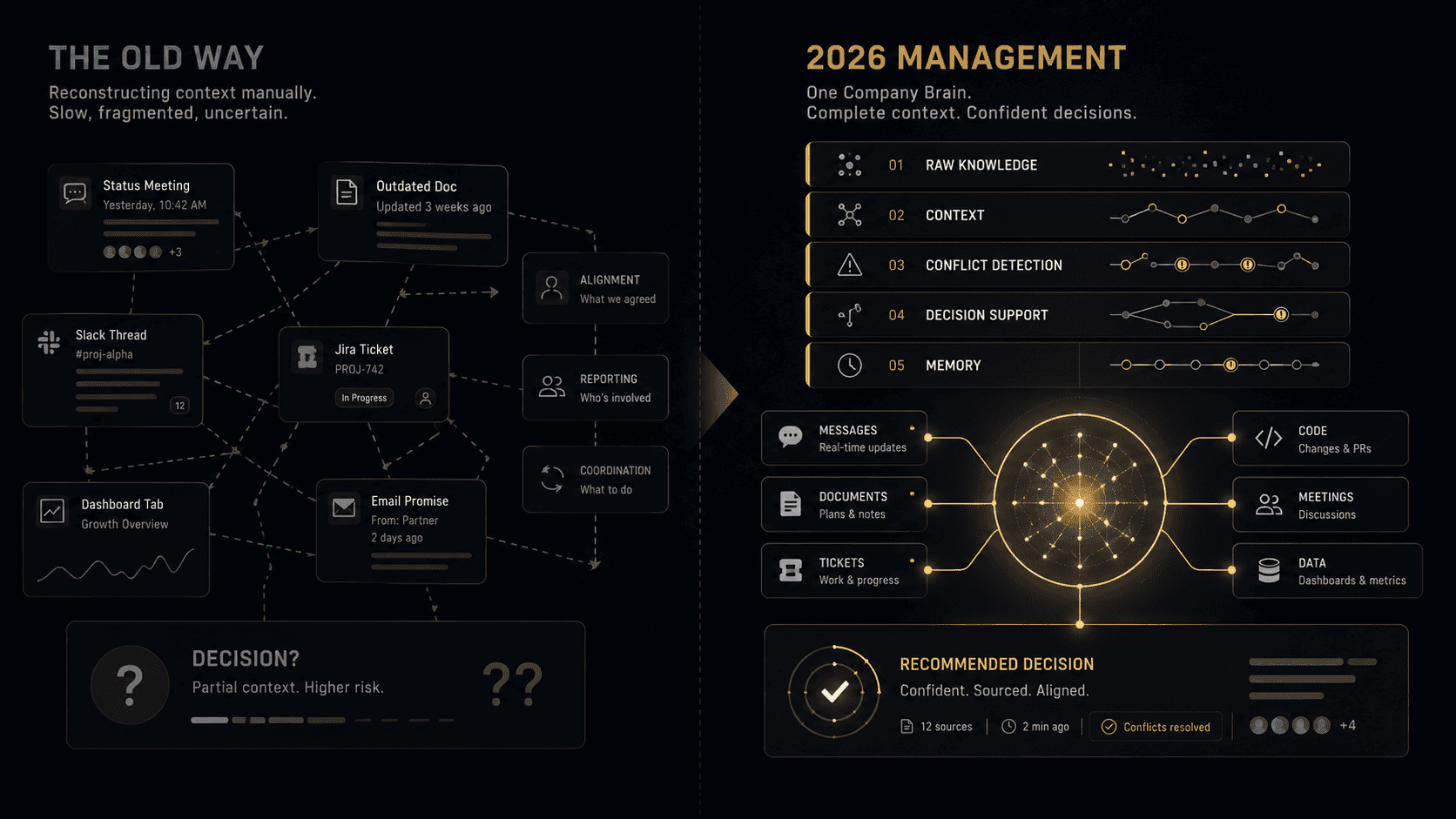
Most companies do not have a decision-making problem because they lack information.
They have the opposite problem.
They have too much information, spread across too many tools, written at different moments in time, by different people, with different levels of accuracy.
A roadmap lives in one document. A product decision happened in Slack. A client expectation was clarified in Gmail. The real technical constraint is buried in GitHub. The latest delivery status is in Jira. A meeting transcript says something different from the project plan.
Leaders reconstruct context manually before every decision.
And then a manager, founder, or director has to make a decision. Not based on reality, but based on whatever context they were able to collect before the next meeting.
This is how many companies still operate in 2026: decision-making by manual context reconstruction.
That model is breaking.
The companies that move faster in 2026 will not be the ones with more dashboards, more documentation, or more meetings. They will be the ones that can turn scattered company knowledge into trusted, current, decision-ready context.
In other words, they will need a Company Brain.
The old model is too slow
For years, companies tried to improve decisions by adding more process: more status meetings, more documentation, more dashboards, more reporting, more project management rituals, and more layers of coordination.
Some of it helped. But it also created a new problem: knowledge debt.
Every decision, discussion, update, and exception leaves a trace somewhere. Over time, those traces become difficult to trust. A document may be well-written but outdated. A Slack thread may be recent but incomplete. A Jira ticket may be accurate but too narrow. A meeting note may capture the conversation but miss the actual decision.
The result is a company where information exists, but confidence does not.
People do not ask, "Do we have this somewhere?" They ask:
- Is this still true?
- Who knows the latest version?
- Did we already decide this?
- Why did we choose this direction?
- Which source should I trust?
- What changed since the last update?
Teams do not lack information. They lack confidence in what is current.
These are not search problems. These are context problems.
And context is becoming the core operating layer of modern companies.
Decisions need context, not just data
Traditional business intelligence was built around structured data: revenue, costs, conversion rates, retention, delivery metrics, support tickets, and sales pipeline.
That data still matters. But many of the most important business decisions are not made from structured data alone.
They depend on messy, qualitative, cross-functional context:
- Should we promise this deadline to a client?
- Should we delay a feature?
- Should we hire another manager or improve team autonomy?
- Should we rewrite this part of the system?
- Should we continue this project?
- Should we change the roadmap?
- Should we escalate this account?
- Should we trust this documentation?
These decisions require more than numbers. They require a living understanding of what the company already knows.
The problem is that company knowledge is not stored in one place. It is distributed across communication, documentation, delivery, engineering, design, customer conversations, and leadership decisions.
That is why the next generation of decision-making will not be built around another static dashboard. It will be built around an AI Brain that understands the company's context across tools, across time, and across teams.
The Decision Intelligence Stack
A modern decision-making system should not simply retrieve documents. It should help leaders understand what is true, what changed, what conflicts, and what options exist.
A useful way to think about this is the Decision Intelligence Stack.
- 5MemoryDecision history, reasoning, and what changed later
- 4Decision supportOptions, trade-offs, assumptions, and sources
- 3Conflict detectionContradictions across roadmap, sales, and delivery
- 2ContextConnected understanding across tools and time
- 1Raw knowledgeSlack, docs, tickets, code, design, and meetings
Each layer turns fragmented information into decision-ready context.
1. Raw knowledge
This is where company knowledge currently lives: Slack, Google Chat, Gmail, Google Drive, Jira, GitHub, Linear, Notion, Confluence, Figma, meeting transcripts, and project documentation.
Most companies already have enough information. The problem is that this information is fragmented.
Each tool gives a partial view of reality. Slack knows what people discussed. Jira knows what work is planned or blocked. GitHub knows what actually changed in the codebase. Google Drive knows what was documented. Gmail knows what was promised externally. Figma knows how the product is evolving.
No single source is enough.
2. Context
The next layer is context. This is where AI becomes useful beyond basic search.
A context layer should be able to connect related information across tools and answer questions like:
- What is the latest understanding of this project?
- What decisions have already been made?
- Which documents are outdated?
- What changed since last week?
- What is blocking this initiative?
- What did we promise the client?
- What does engineering know that leadership may have missed?
This is where a Company Brain starts to become more valuable than another knowledge base.
A knowledge base stores information. A Company Brain interprets company context.
3. Conflict detection
One of the biggest hidden costs in companies is conflicting information.
A roadmap says one thing. A sales promise says another. A Jira ticket shows a different priority. A Slack thread changed the direction. A meeting summary contains an old assumption.
Most teams do not detect these conflicts early. They discover them during execution, often when the cost is already high.
In 2026, decision-making systems should actively detect contradictions. Not just answer, "Here is the document." But explain:
This document says the launch is planned for March, but the latest Jira epic moved the delivery estimate to April. There is also a Slack discussion from last week suggesting the scope changed.
That is the difference between information retrieval and decision support.
4. Decision support
AI should not replace human judgment. But it should dramatically reduce the amount of manual work required before judgment can happen.
A good AI Brain should help leaders see the current situation, the relevant history, the conflicting sources, the likely options, the trade-offs, the assumptions behind each option, and the sources supporting the answer.
This changes the role of leadership.
Instead of spending time collecting status, chasing updates, and reconstructing context, leaders can spend more time making decisions.
Not AI replacing leaders. AI removing the friction around leadership.
5. Memory
The final layer is memory.
Most companies forget why they made decisions. They remember the outcome, but not the reasoning.
Six months later, someone asks:
- "Why did we choose this architecture?"
- "Why did we stop working on this feature?"
- "Why did we prioritize this client?"
- "Why did we change the onboarding process?"
- "Why did this project fail?"
And the answer is usually hidden in a mix of old threads, documents, meetings, and personal memory.
A Company Brain should preserve not only information, but decision history: what was decided, why it was decided, who was involved, what assumptions were made, and what changed later.
This creates organizational learning. Without it, companies repeat the same discussions with different people.
The future of management is not more hierarchy
Many companies respond to information chaos by adding more management: more people responsible for alignment, reporting, coordination, and turning fragmented information into something leadership can understand.
But this is an expensive way to solve a knowledge infrastructure problem.
In many organizations, a large part of management work is not pure leadership. It is information relay.
Managers ask for updates. They summarize status. They connect people. They check what is true. They repeat context. They explain decisions. They make sure teams are aligned.
Some of this will always require human judgment, trust, and leadership. But a growing part of this work is context processing.
And context processing is exactly where AI can help.
The best companies will not remove managers and replace them with chatbots. That is the wrong framing. They will remove the need for managers to act as human routers of company knowledge.
That means fewer status meetings, fewer repeated questions, fewer outdated documents, fewer decisions made from partial context, and fewer people acting as the only bridge between teams.
The role of management becomes more strategic:
- Less "let me find the answer."
- More "let me decide what we should do."
What good decision-making should look like
In 2026, a leader should be able to ask questions like:
- "What is the current state of Project X?"
- "What changed since our last leadership meeting?"
- "Are there any contradictions between what we promised the client and what engineering can deliver?"
- "Which documents about this process are outdated?"
- "What are the main risks before we commit to this deadline?"
- "What did we decide about this feature and why?"
- "What context should I know before joining this customer call?"
- "Which teams are blocked and by what?"
- "What are the options based on the current company knowledge?"
And they should not receive a list of documents.
They should receive a sourced, contextual answer, with citations, timeline awareness, conflicts highlighted, outdated assumptions marked, and clear options.
That is what decision-making should look like. Not because AI should make every decision, but because humans should not have to manually rebuild the company's memory every time they need to make one.
Search is not enough
- 10 documents about the project
- No sense of what is current
- Conflicts stay hidden
- Leader still has to interpret
- Current state with citations
- Outdated sources flagged
- Conflicts surfaced early
- Options and trade-offs visible
Finding documents is not the same as understanding what is true.
A search tool helps you find something. But decision-making requires more than finding. It requires understanding.
A search tool can show you ten documents about a project. A Company Brain should tell you which one is current, which one is outdated, what changed, what conflicts, and what the company appears to know right now.
That difference matters because leaders do not need more tabs.
They need trusted context.
They need to know what is true enough to act on.
This is especially important for knowledge-heavy companies: software houses, product teams, agencies, consulting firms, R&D teams, and growing startups.
These companies do not produce value only through tasks. They produce value through decisions. And every poor decision made from outdated context compounds into wasted time, rework, missed expectations, and organizational drag.
The Company Brain as a decision layer
This is where Odin fits.
Odin is not meant to be another place where teams manually write documentation.
It is a Company Brain: a decision layer over the tools your company already uses.
- Scattered tools
- Company Brain
- Trusted context
- Better decisions
Odin connects existing tools instead of asking teams to rewrite knowledge.
Instead of forcing people to move all knowledge into one perfect system, Odin works with the reality of how companies operate. People talk in Slack or Google Chat. They plan in Jira or Linear. They write in Google Drive, Notion, or Confluence. They build in GitHub. They design in Figma. They discuss decisions in meetings and email.
Odin connects that scattered knowledge and turns it into trusted context for better management decisions.
The value is not only asking questions. The value is knowing whether the answer reflects the current state of the company.
That is the hard part.
Because in modern companies, the most dangerous information is not missing information.
It is outdated information that still looks correct.
The companies that win will decide faster
Speed matters.
But speed without context creates chaos.
The future of decision-making is not about making decisions instantly. It is about reducing the time between a question and a well-informed decision.
That means leaders need access to the company's living context. Not the context someone manually prepared for a meeting. Not the context trapped in one manager's head. Not the context hidden in a Slack thread from three weeks ago. Not the context from a document that nobody updated.
They need the current, connected, sourced version of reality.
In 2026, the best companies will not ask, "Where is this information?"
They will ask, "What does our company know about this right now?"
And the companies that can answer that question will make better decisions, with fewer meetings, less knowledge debt, more trust, more autonomy, and less dependency on hierarchy.
That is the shift from documentation to intelligence.
- DocumentationIntelligence
- SearchContext
- CoordinationUnderstanding
And it is why every knowledge-heavy company will eventually need a Company Brain.