Every growing company eventually says the same thing: "We need a single source of truth."
It sounds like the obvious solution. One place where everyone can see what is happening, what has been decided, what changed, what matters, and what is still true.
But modern companies do not really work that way.
The truth about a company rarely lives in one system. It lives across Slack threads, Jira tickets, Google Drive folders, Gmail conversations, GitHub comments, Linear updates, Figma files, meeting notes, customer calls, roadmap decks, onboarding docs, and the memory of people who have simply been around long enough to remember why things are the way they are.
None of these sources are useless. Most of them are valuable. Slack knows what was discussed. Jira knows what is being worked on. Google Drive knows what someone documented. Gmail knows what the customer was promised. GitHub knows what is technically possible. Meeting notes know what was said. People remember what was meant.
The problem is that each source only holds part of the truth.
So when a leader needs to make an important decision, the real question is not "Where is the document?" The real question is: "What does the company know about this right now?"
That is where most companies break. They do not have one source of truth. They have many sources of maybe.
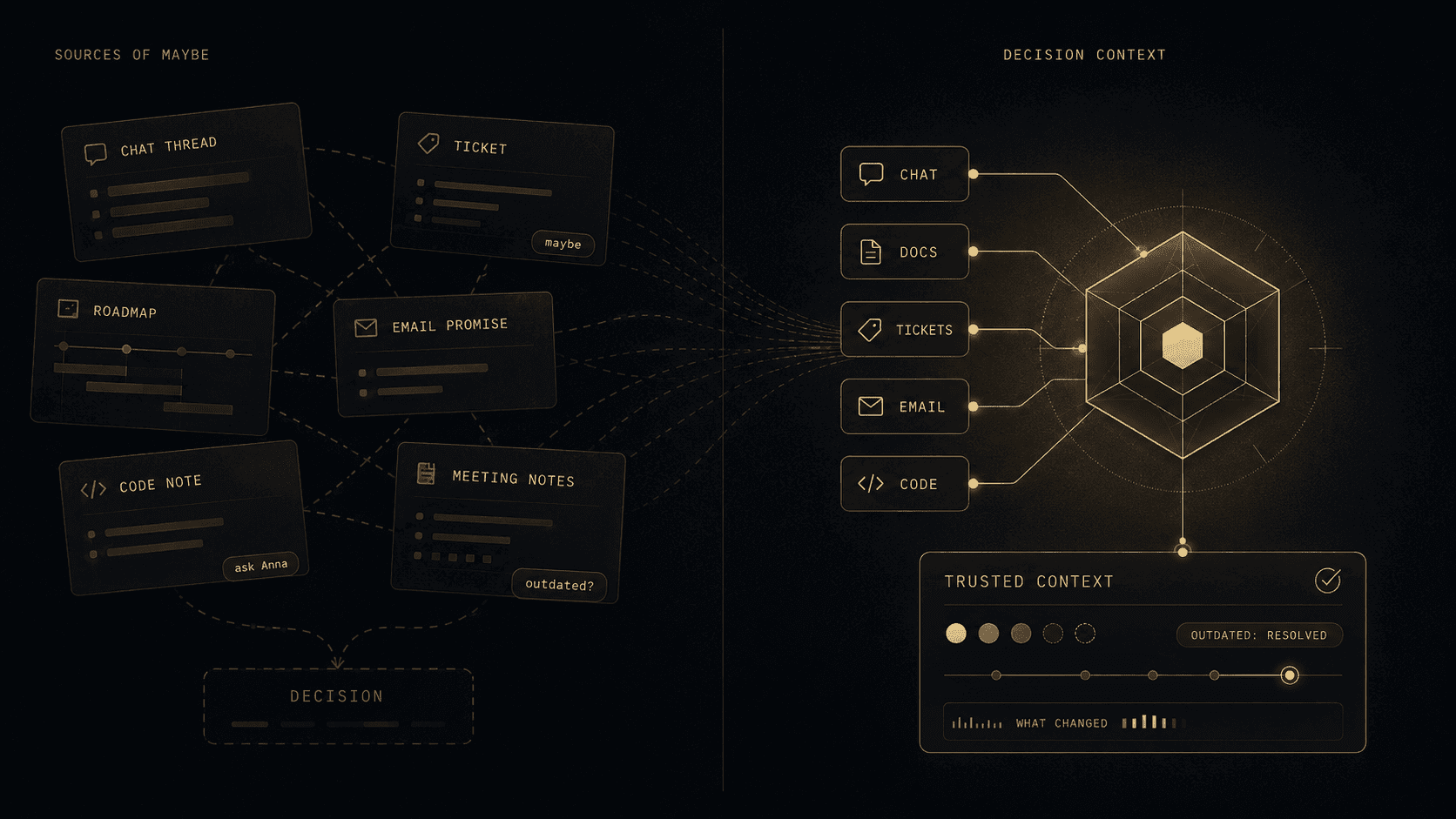
The diagram below shows what that fragmentation looks like before every important decision.
Each tool holds part of the truth. None of them guarantees what is still current.
The problem is not lack of information
Most companies are not information-poor. They are drowning in information.
Every project has documents. Every team has channels. Every decision has a meeting. Every customer has a thread. Every roadmap has a deck. Every process has some page somewhere that probably used to be true.
The issue is not that the company does not know enough. The issue is that it cannot reliably use what it already knows when the moment of decision arrives.
Before making a strategic, delivery, product, engineering, or client-facing decision, leaders first need to rebuild the situation from fragments. They need to understand what changed since the last meeting, which version of the roadmap is current, whether the client already heard a different commitment, whether engineering flagged a constraint, whether this was already decided, and whether the documentation is still accurate.
This work often looks like management, but it is not really decision-making. It is context reconstruction.
And in many companies, context reconstruction has become the hidden tax on every important decision.
These are the fragments leaders rebuild before they can decide:
- What changed since the last meeting?
- Which roadmap version is current?
- Did the client hear a different promise?
- Did engineering flag a constraint?
- Was this already decided?
- Is the documentation still accurate?
Context reconstruction looks like management work, but it is not decision-making yet.
Why search is not enough
The obvious answer is to make company knowledge searchable.
Connect the tools. Index the documents. Add AI search. Let people ask questions.
This helps, but it does not fully solve the problem, because search gives you information while decisions need context.
A search result can show you a document, but it may not tell you whether that document is still true. It can find a roadmap, but it may not explain that engineering later changed the timeline. It can surface a customer note, but it may not connect it to the Jira ticket where the delivery risk was discussed. It can summarize a meeting, but it may not show that the decision was later changed in Slack.
This is the difference between finding knowledge and understanding the current state of reality.
Generic AI search answers the question: "Where is the information?"
Leaders usually need a different answer: "What should we understand before deciding?"
That is a different category of problem.
Search and decision context answer different questions:
- Where is the information?
- Returns a doc, not current state
- Finds roadmap, misses timeline change
- Surfaces note, not linked Jira risk
- Summarizes meeting, misses Slack reversal
- What should we understand?
- Current picture with sources
- Outdated docs flagged
- Customer promise linked to delivery
- Decision change traced across tools
Search answers where knowledge lives. Decisions need to know what is still true.
Why documentation is not enough either
The second answer is documentation.
Write better docs. Create a better wiki. Update the knowledge base. Document decisions. Define ownership. Create templates. Set reminders.
All of this is useful. But it depends on one fragile assumption: people will remember to maintain the system manually.
In reality, knowledge work moves faster than documentation. A decision happens in a meeting. A constraint appears in a Slack thread. A customer promise is made in an email. A ticket changes scope. A technical tradeoff is discussed in GitHub. A process changes because one team found a better way.
Unless someone remembers to write it down, tag it correctly, file it in the right place, and update every related page, the documentation starts drifting away from reality.
At first, the gap is small. Then people start saying things like: "I think this is still current", "Ask Anna, she probably knows", "This doc might be outdated", or "Let's confirm in the meeting."
That is the moment your knowledge base becomes one more source of maybe.
Not because documentation is bad, but because static documentation cannot keep up with dynamic work.
Meetings become the workaround
When companies cannot trust their context, they create more meetings.
Not always because they want more meetings, but because meetings become the fastest way to reconstruct reality.
A leadership meeting becomes a context recovery session. A roadmap meeting becomes a status investigation. A client escalation becomes a search party. A planning session becomes a debate about which version of the truth is still true.
People spend the first half of the meeting trying to understand what changed, and then rush the actual decision.
This is why many companies do not really have a meeting problem. They have a memory problem.
The meeting is just the visible symptom. The deeper issue is that the company cannot access its own current knowledge in a decision-ready form.
So it compensates with coordination: more meetings, more updates, more status checks, more managers, more reporting, more "can you send me the latest version?"
But more coordination does not necessarily create better decisions. Often, it only hides the fact that the company's context layer is broken.
The dangerous document is not the missing one
Most teams worry about missing documentation. But missing documentation is not always the biggest risk.
The more dangerous document is the outdated one that still looks correct.
A missing document creates uncertainty. An outdated document creates false confidence. That is worse.
A leader reads the old roadmap and assumes the date is still valid. A delivery manager checks an old process and misses the exception. A product manager uses a customer insight that has since changed. An engineer follows an architecture note that no longer reflects the actual system. A founder reviews a deck that does not include the latest client constraint.
The company has information. But the information no longer matches reality.
This is where bad decisions often begin, not from bad judgment, lack of intelligence, or lack of effort, but from outdated context.
The real source of truth is not a place
The phrase "single source of truth" suggests that truth is a location: one system, one page, one database, one dashboard, one place everyone should check.
But in a modern company, truth is rarely static. It is usually a current relationship between sources.
The truth about a roadmap may require the roadmap doc, the Jira status, the customer email, the engineering constraint, the leadership decision, and the latest meeting summary.
The truth about a client may require CRM notes, support tickets, delivery updates, Slack discussions, invoices, and promises made by sales.
The truth about a technical decision may require GitHub, architecture docs, incident notes, security comments, and the original tradeoff discussion.
No single source contains the whole truth. The truth emerges when the right sources are connected, compared, and understood in context.
That is why the next step is not just a better wiki, better search, or another dashboard.
It is a decision context layer.
What a decision context layer does
A decision context layer helps the company understand what it already knows before a decision is made.
Not as isolated documents. Not as disconnected search results. Not as tribal knowledge. But as current, sourced, permission-aware context.
Before a decision, a leader should be able to ask:
- What changed since the last planning session?
- What is still true?
- What did we already agree?
- Which sources contradict each other?
- Which customer promises matter here?
- Which technical constraints were raised?
Decision context answers what leadership should understand, not where a document lives.
That is the difference between searching for information and preparing for a decision.
The output should not be "here are five documents." It should be closer to: here is the current picture, here is what changed, here is what appears outdated, here are the sources, here are the tradeoffs, and here is what leadership should know before deciding.
This is the shift from knowledge management to decision context.
A Company Brain is not a place to store everything
This is also where the idea of a Company Brain becomes important.
A Company Brain is not another folder. It is not a chatbot on top of documents. It is not a dumping ground for every piece of company information. And it should not be an AI system with unlimited access to everything just because it technically can.
A real Company Brain must know two things: what to show and what not to show.
That means sources matter. Permissions matter. Access control matters. Auditability matters.
Context without security becomes risk. AI without sources becomes noise.
The goal is not to give everyone access to everything. The goal is to help the right people understand the right context at the right moment, with boundaries respected.
That is what makes company memory usable.
The future is not one perfect source of truth
The future of company knowledge is not forcing every team into one perfect system.
That will not happen.
Teams will keep using different tools because different work needs different tools. Engineering will live in GitHub and Jira. Product will live in roadmaps, research docs, and customer feedback. Sales and customer teams will live in email, CRM, and call notes. Leadership will live in decks, meetings, dashboards, and strategy documents. Operations will live in processes, spreadsheets, and internal systems.
Trying to collapse all of that into one static source of truth is usually unrealistic.
The better question is whether the company can understand what is true across these systems when it needs to decide.
That is the real challenge. Not one source of truth, but one trusted way to understand the current context.
This changes how management works
When company context is broken, managers become routers of information.
They chase updates, repeat answers, reconstruct history, connect people, and explain decisions that should have been captured. They turn scattered knowledge into temporary clarity.
That work is valuable, but it does not scale well.
As the company grows, more and more management time goes into moving context between teams. The organization becomes heavier. Decisions slow down. People wait for alignment. Leaders spend more time asking "what is going on?" than deciding what to do next.
But when company memory becomes usable, management changes.
Leaders can prepare faster. Teams can answer repeated questions without interrupting the same people. Decisions can build on previous decisions. Meetings can focus on judgment instead of reconstruction. Documentation can stay closer to reality. The company becomes less dependent on folklore.
That is the shift:
Context over hierarchy. Memory over meetings. Sources over folklore.
From many sources of maybe to decision-ready context
Your company will probably never have one perfect source of truth.
And that is fine.
The real problem is not that knowledge lives in many places. The real problem is that leaders cannot tell what is current, what changed, what matters, and what can be trusted when a decision needs to be made.
That is the cost of knowledge debt.
The company already knows more than it can use. The answer is not more meetings, more dashboards, or another knowledge base that becomes outdated in six months.
The answer is a living layer of company context built from the work already happening across tools, teams, projects, and decisions.
A way to ask the company what it already knows.
A way to see the current version of reality.
A way to make decisions with sources instead of assumptions.
Because better decisions do not start with more information.
They start with better context.
Where Odin fits
Odin is building the decision context layer for growing digital companies.
It turns scattered project, client, and company knowledge from tools like Slack, Jira, Google Drive, Gmail, meetings, GitHub, and Linear into current, decision-ready answers.
So before a strategic, delivery, or client-facing decision, management teams can understand what changed, what is still true, and what was already agreed, in minutes, not hours.
Not to replace leadership. To give leadership better context.
Odin connects the tools your company already uses into one decision layer over scattered knowledge.
- Sources of maybe
- Decision context layer
- Current picture
- Decisions with sources
Odin connects existing tools into answers leadership can trust before deciding.
The companies that close the gap between scattered knowledge and trusted context will decide faster without deciding carelessly.
- HierarchyContext
- MeetingsMemory
- FolkloreSources
Better decisions start with better context, not more information.